Eight Times Primate Horror Went Ape....

Anticipation is building for Johannes Roberts' Primate (2026) as the new American horror-thriller about a genetically altered chimp who escapes from a research facility.

Set to be screened in the UK from the 30th of January 2026, Primate's release is a perfect moment to revisit horror cinema's fascination with primate terror. Like its predecessors in the primate horror genre, Primate taps into fears that humanity's exploitation of animals and nature will rebound in monstrous ways. From the rampaging figure of King Kong to lab-born viruses in zombie films like 28 Days Later (2002), primate horror asks what happens when animals push back against human ego? Below are some of the most unforgettable moments in primate horror history.
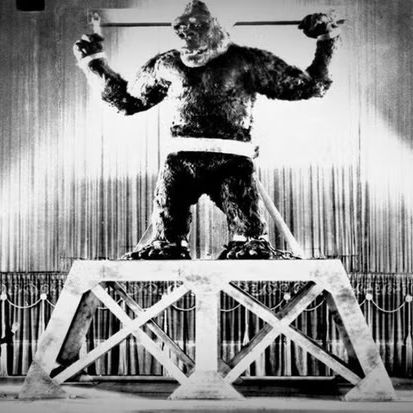
Film Still from King-Kong

Film still from King Kong. Directed by Merian C. Cooper and Ernest B. Schoedsack, RKO Radio Pictures, 1933

1. King Kong Breaks Free in King Kong (1933)

Merian C. Cooper and Ernest B. Schoedsack's adaptation of King Kong is the template for all cinematic horror and sci-fi about primates. The film's most electrifying moment comes when Kong escapes captivity in New York. Until this point, Kong (brought to life through Willis O'Brien's stop-motion animation) has been a tragic, misunderstood creature torn from Skull Island and paraded before a paying audience.

Kong's rampage leads to the destruction of New York. Kong is an unstoppable force of nature. The miniature cityscapes turn New York into a toy world. Kong's destruction of New York captures one of the central themes in primate horror: that humanity's belief that it can control the natural world will backfire.

2.  The revenge of the super-intelligent ape in Link (1986)

Richard Franklin's Link is one of the lesser-known British films in the primate horror genre. Set in a remote country house, the film follows Jane, a student left alone with a super-intelligent ape named Link, who has been trained as a butler by her professor. When her professor disappears under suspicious circumstances, we realise that Link is highly resentful of his human masters and looking for revenge for his imprisonment. The horror lies in watching human authority slip away as Link comes to understand his physical power and ability to inflict revenge on humans.

3. Lab breakout in George A. Romero's Monkey Shines (1988)

George A. Romero's Monkey Shines is a medical thriller that offers one of the strangest entries in the primate horror genre. Monkey Shines is about a medical programme designed to create intelligent helper monkeys for disabled patients. When a genetically altered monkey, Ella, breaks free, she doesn't rampage. She is far more calculated, bumping off characters one by one (including killing a surgeon by burning down his cabin and electrocuting a woman by dropping a hairdryer in her bath). Romero's satire is a classic Frankenstein-like tale in which a well-meaning scientist is convinced he can improve nature without consequence.

4. Gorilla guarded diamond Mines in Congo (1995)

Frank Marshall's science-fiction film Congo blends Indiana Jones-style adventure cinema with primate horror by featuring genetically altered gorillas engineered to guard diamond mines. With Congo is one of the pulpier and bloodier entries on this list, with scenes of gorillas ripping human explorers' limb from limb, its killer gorillas remain a lurid expression of humanity's fear that science can create something smarter and stronger than humans.

5. The Viral Contagion in Outbreak (1995)

While primarily a medical thriller, Outbreak is a memorable example of 1990s contagion horror about viral pandemics. Smuggled into the US via an illegal animal trade, an infected capuchin monkey becomes a walking bioweapon when it is infected with an Ebola-like virus. Director Wolfgang Petersen focuses on clinical details with shots of protective suits and CDC briefings. Outbreak thus reframes primate horror for the modern age. The ape is not a physical attacker. Instead, it is a biological time bomb that spreads through global travel networks and can reach all parts of the world.

28 Days Later Film Still

Film still from 28 Days Later. Directed by Danny Boyle, DNA Films / Fox Searchlight Pictures, 2002

6. The Rage Virus in 28 Days Later (2002)

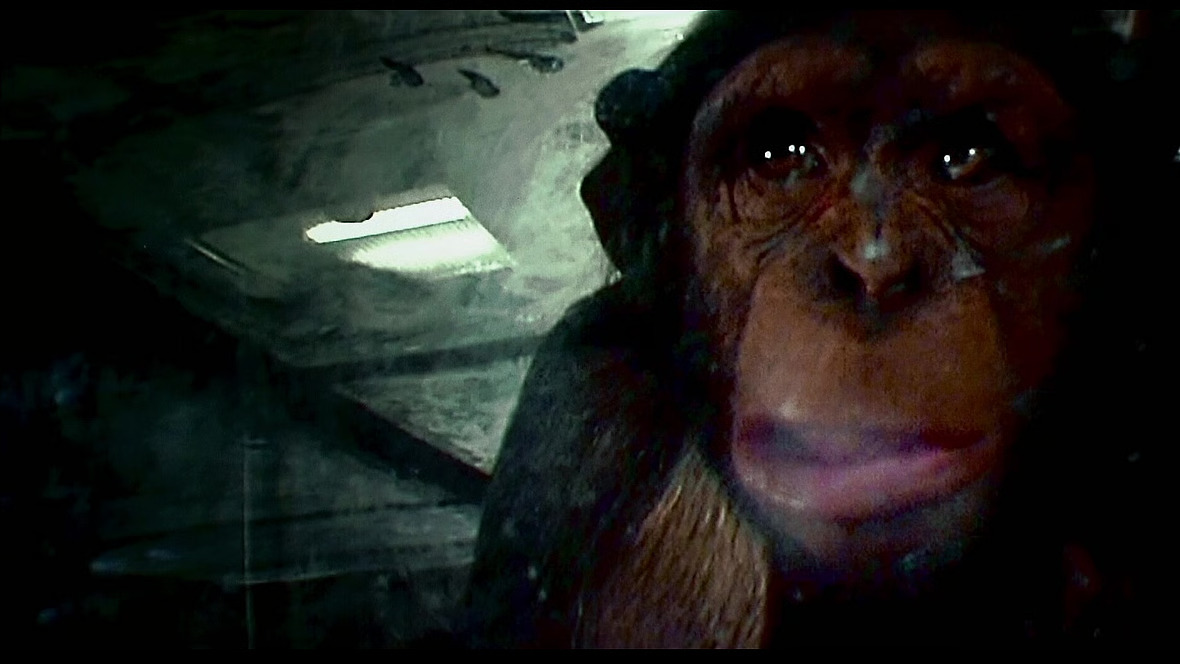
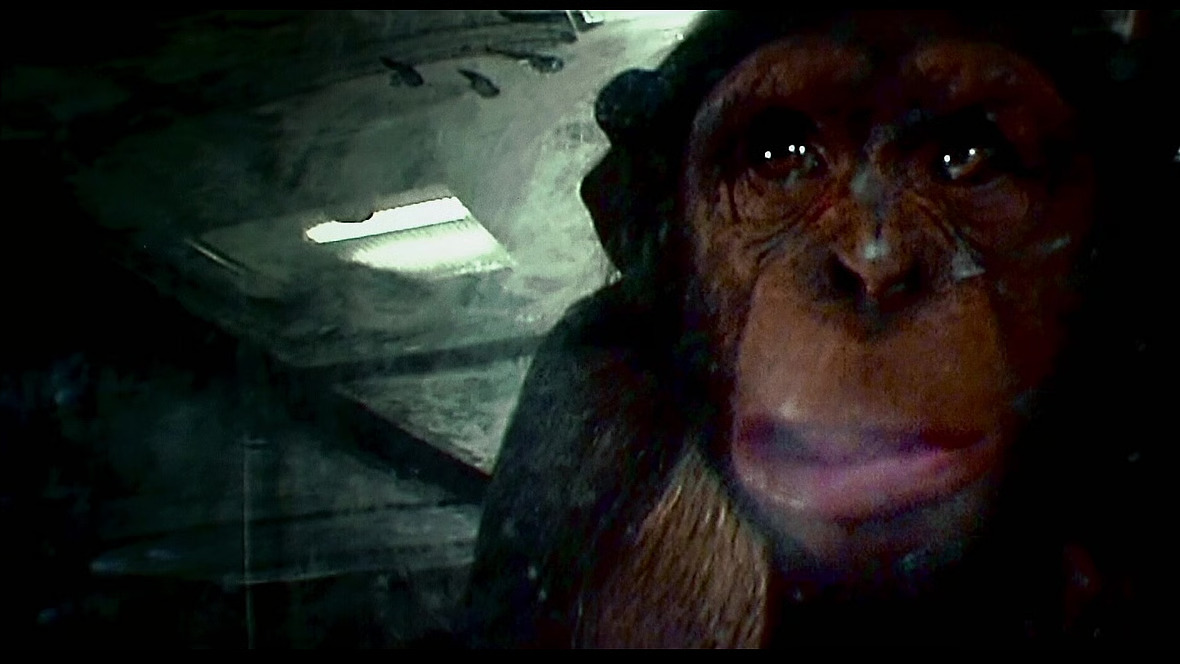
Danny Boyle's 28 Days Later famously opens when animal rights activists free infected chimps from a Cambridge research lab. These chimps are test subjects in experiments that infect them with a "Rage Virus" to study human anger. When the chimps attack, the "Rage Virus" spreads across the UK within a matter of weeks. As a result, modern civilisation falls within a matter of months, all before the opening credits.

In the first of Boyle's memorable zombie franchise, the apocalypse does not begin with nuclear war or alien invasion, but with animal research. The chimps are victims, and yet they become the vector for human extinction. Humanity creates the monster, and humanity pays the price.

7.  Caesar's Escape in Rise of the Planet of the Apes (2011)

Super-intelligent chimps are a recurring trope in primate horror, punishing humans for their hubris and mistreatment of animals. This scene in Rise of the Planet of the Apes focuses on a breakout from a primate sanctuary. Caesar, introduced in the film as the son of a lab chimp used in Alzheimer's research, and exposed before birth to an experimental drug that grants him heightened intelligence, moves through the facility with human-like control. He unlocks cages and silently coordinates their escape. The horror lies in watching an ape, shaped by human experiments, recognise the power humans have given him.

Film Still from Nope

Film still from Nope. Directed by Jordan Peele, Universal Pictures and Monkeypaw Productions, 2022

8.  Gordy's Rampage in Nope (2022)

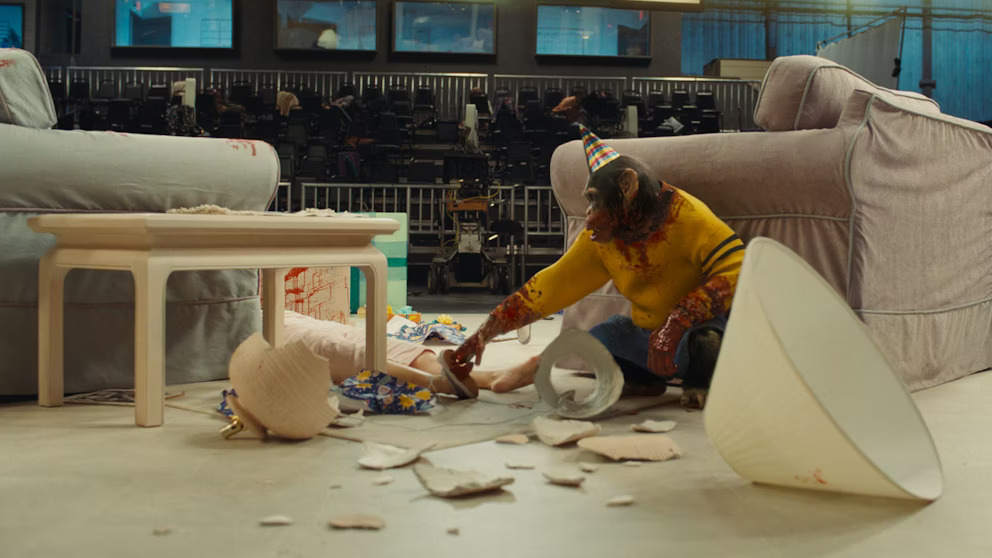
Jordan Peele's Nope is, on the surface, a UFO-themed science-fiction film. And yet, one of its most gory sequences belongs to the primate horror genre. The Gordy subplot, which depicts a chimpanzee who snaps during the taping of a 1990s family sitcom, is part horror and part Hollywood satire.

Before the attack, the sitcom TV set already feels surreal. The staged family dynamic is forced, and the set's artificial colours give the scene a surreal, children's party feel. Peele stages the attack from the perspective of one of the child actors who is trapped under the table as Gordy the chimp moves through the blood-soaked set. Gordy is a confused animal pushed to breaking point by human demands. Nope's primate horror is a reflection on the consequences of the extreme demands of Hollywood entertainment.

Across decades of cinema, primate horror has repeatedly warned that when humans exploit nature, the consequences can be monstrous. The horror sub-genre forces us to confront the cost of human ambition and ego. In the end, primate horror asks us to fear what happens when we play God.

For full reviews, interviews, and festival coverage, visit the Dead Northern Blog.

Christina Brennan

GET TICKETS FOR THE LATEST EVENT

Join-the-dead-norrthern-newsletter

Want Discounts, Freebies & VIP Perks?

Sign up to unlock ticket deals, merch offers & exclusive competition access.